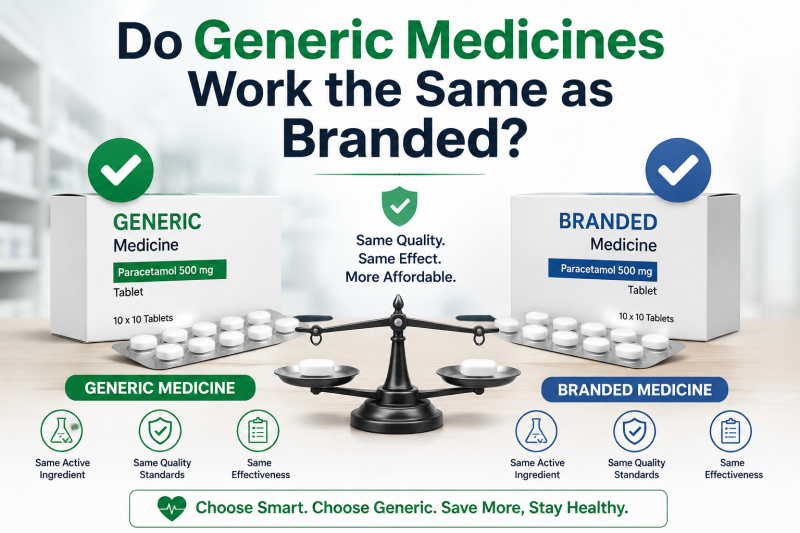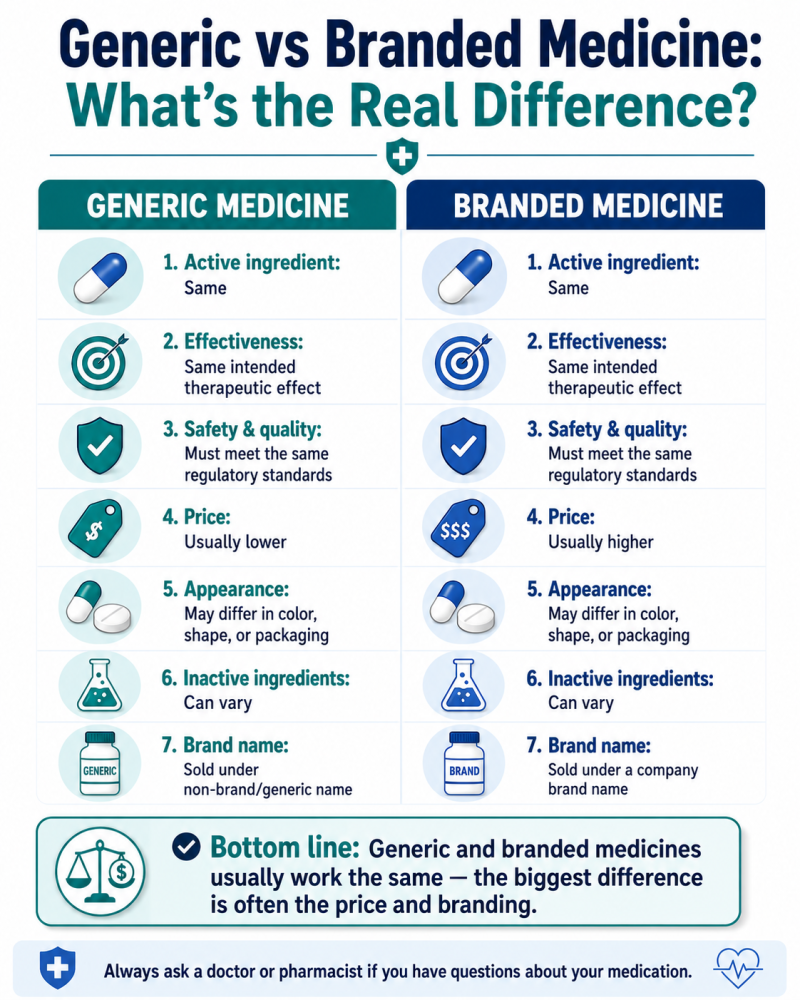
Yes — generic medicines are good for your health. They contain the same active ingredient, in the same strength and dosage form, as their branded equivalents. They are approved by India's drug regulator, manufactured in licensed facilities, and required to work the same way in your body. The science and the regulations both say the same thing: generic medicines are as effective and as safe as branded ones — the difference is price, not quality.
At our pharmacy in Moosapet, we hear this question in a slightly different form every week: "Doctor prescribed this branded medicine — can I take the generic?" The answer, in most cases, is yes. Here is why, with the evidence to back it.
What makes a generic medicine "good"?
A medicine is considered good when it does what it is supposed to do — relieves the condition it targets, without causing unnecessary harm. For a generic to be legally sold in India, it must meet three non-negotiable criteria set by the Central Drugs Standard Control Organisation (CDSCO):
Same active ingredient: the salt — the actual molecule that treats your condition — must be identical to the original branded version in chemical composition, strength, and dosage form.
Same quality standards: manufacturing facilities must be licensed and inspected. Products must pass purity, stability, and potency tests before they reach a pharmacy shelf.
Bioequivalence where required: for many categories of medicine, the generic must prove bioequivalence — meaning it releases the same amount of active ingredient into your bloodstream, at the same rate, as the branded drug. Same delivery, same effect.
Are generic medicines effective?
Yes. Because the active ingredient is chemically identical, your body cannot tell the difference between a branded and a generic version of the same salt. The therapeutic effect — how quickly pain relieves, how well blood pressure drops, how effectively an infection clears — is the same.
What can differ between a branded and generic version are the inactive ingredients: the binders, coatings, fillers, and colourants that hold the tablet together or give it its appearance. These do not affect how the medicine works in your body. If your tablet looks slightly different after switching to a generic, this is why — same medicine, different packaging.
Are generic medicines safe in India?
Yes — when purchased from a licensed pharmacy. India's generic medicines industry is the largest in the world, supplying over 60 countries. Indian generic manufacturers are regulated by CDSCO under the Drugs and Cosmetics Act, the same law that governs branded medicines. The regulator does not operate a lower standard for generics.
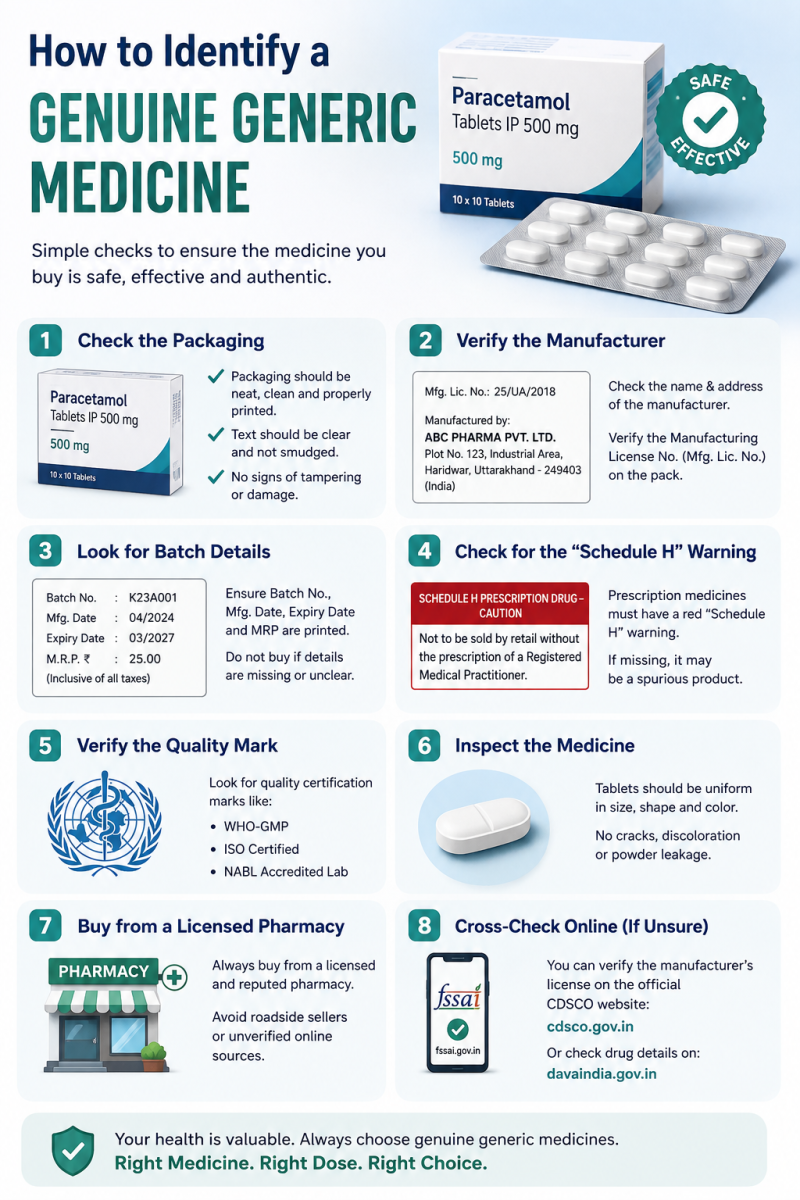
The risk of unsafe medicine in India comes primarily from unlicensed or counterfeit sources — not from generics as a category. Buying from a licensed, registered pharmacy is the key safeguard, regardless of whether you choose branded or generic.
Government programmes built on generics: Jan Aushadhi
India's own government runs the Pradhan Mantri Bhartiya Janaushadhi Pariyojana (Jan Aushadhi) — a nationwide network of over 10,000 stores selling quality-tested generic medicines at prices 50–90% below branded equivalents. The entire programme is built on the premise that generic medicines are as good as branded ones. This is not a fringe view — it is official government health policy.
When are generics not the best choice?
For most everyday medicines — pain relief, antibiotics, antacids, vitamins, diabetes and blood pressure medications — generics are an excellent choice. However, there are specific situations where caution is warranted:
Narrow therapeutic index medicines: a small group of drugs — certain thyroid medications (levothyroxine), anti-epileptics (phenytoin, valproate), blood thinners (warfarin) — require very precise blood levels to work safely. For these, switching between manufacturers (even between two generics) should only happen with your doctor's guidance, and once switched, you should stay consistent with one manufacturer.
After surgery or complex treatment: if your specialist has prescribed a specific formulation for clinical reasons, always check before switching.
For everything else — and that covers the majority of medicines used by most families — switching to a quality generic from a licensed pharmacy is safe and sensible.
How much can switching to generics benefit your health budget?
For families managing chronic conditions like diabetes, hypertension, or thyroid — where medicines are taken every day for years — the savings from switching to generics typically run to thousands of rupees annually. That money can go towards better food, preventive health checks, or simply reducing the financial stress that itself has a measurable effect on health outcomes.
At Scanda Enterprises, we regularly see customers reduce their monthly medicine bill by 40–60% by switching to generic equivalents of their prescriptions — same salt, same strength, different price.
How to know if a generic is right for your prescription
Step 1: Bring your prescription or current medicine strip to a registered pharmacist.
Step 2: Ask: "Is there a generic equivalent for this salt and strength?"
Step 3: The pharmacist will match the active ingredient — not just a similar-sounding name — and flag any medicines where your doctor's sign-off is advisable before switching.
Step 4: Once switched, stay with the same generic manufacturer where possible, especially for medicines you take long-term.
At Scanda Enterprises in Moosapet, our registered pharmacist is available 24 hours a day, 7 days a week. You can walk in with your prescription, or WhatsApp it to 86880 60339 and we will tell you the generic options and current prices before you make the trip.
Frequently asked questions
Is generic medicine good for health?
Yes. Generic medicines contain the same active ingredient as branded drugs and are approved by CDSCO to the same quality and safety standards. They work the same way in your body and are good for your health in the same way the branded version is.
Are generic medicines effective?
Yes. The active ingredient is chemically identical to the branded version. Where required by the regulator, generics must also prove bioequivalence — that they deliver the same amount of medicine into your bloodstream at the same rate as the original.
Are generic medicines safe in India?
Yes, when bought from a licensed pharmacy. Generic medicines in India are regulated by CDSCO under the same law as branded medicines. The risk of unsafe medicine comes from unlicensed or counterfeit sources, not from generics as a category.
Is Jan Aushadhi medicine good quality?
Yes. Jan Aushadhi medicines are procured through a government quality-testing process and sold through approved outlets. They are generics, and like all licensed generics, contain the same active ingredient as their branded equivalents.
Are there medicines where I should not switch to a generic?
A small group of narrow therapeutic index medicines — certain thyroid, epilepsy, and blood-thinning drugs — require careful management when switching. Always consult your doctor before changing these. For the vast majority of medicines, switching to a quality generic from a licensed pharmacy is safe.
Where can I buy quality generic medicines in Moosapet, Hyderabad?
Scanda Enterprises, 11-5-266/2, Main Road, Bharat Nagar, Moosapet, Hyderabad 500018 — open 24 hours, 7 days a week. Call 86880 60339 or 080087 20077, or WhatsApp your prescription for pricing and availability.
This article is for general information and is not a substitute for medical advice. Always consult your doctor or a registered pharmacist before changing any medicine, particularly if you are managing a chronic condition.