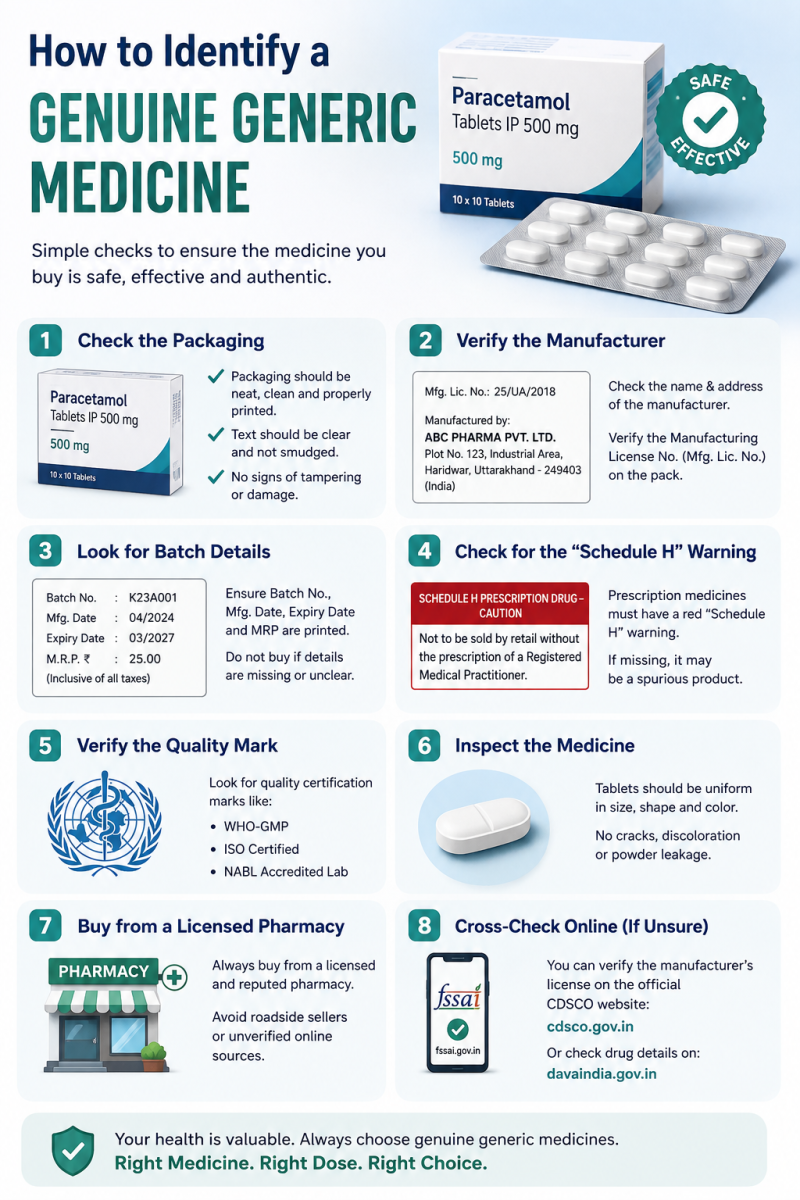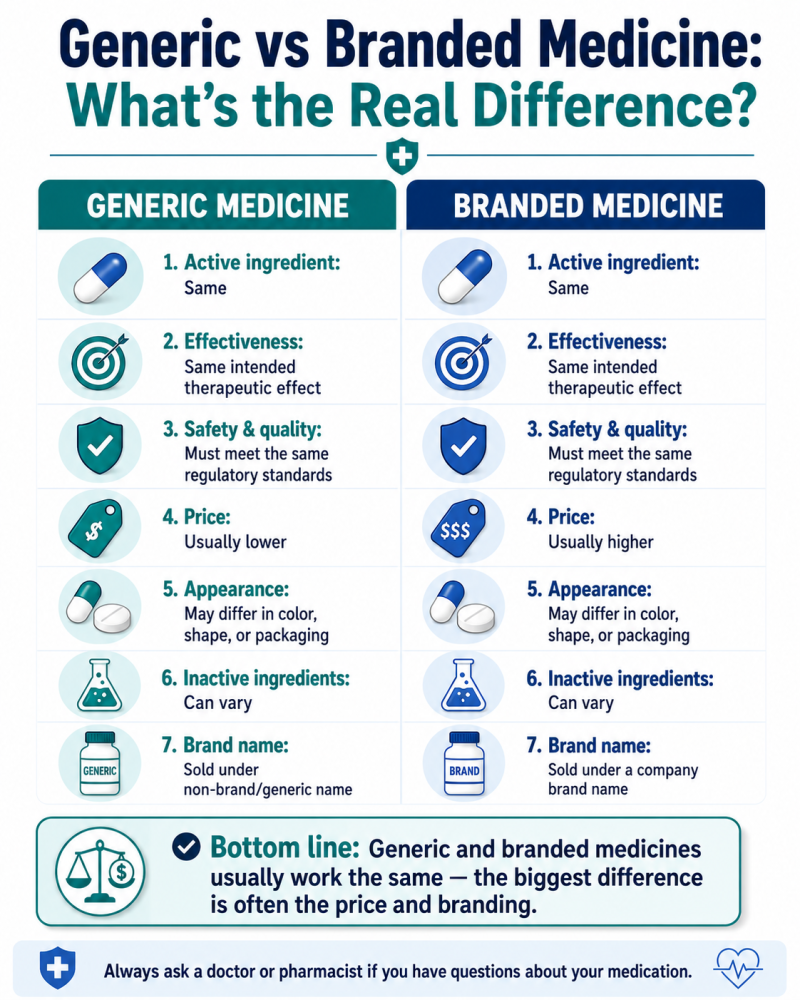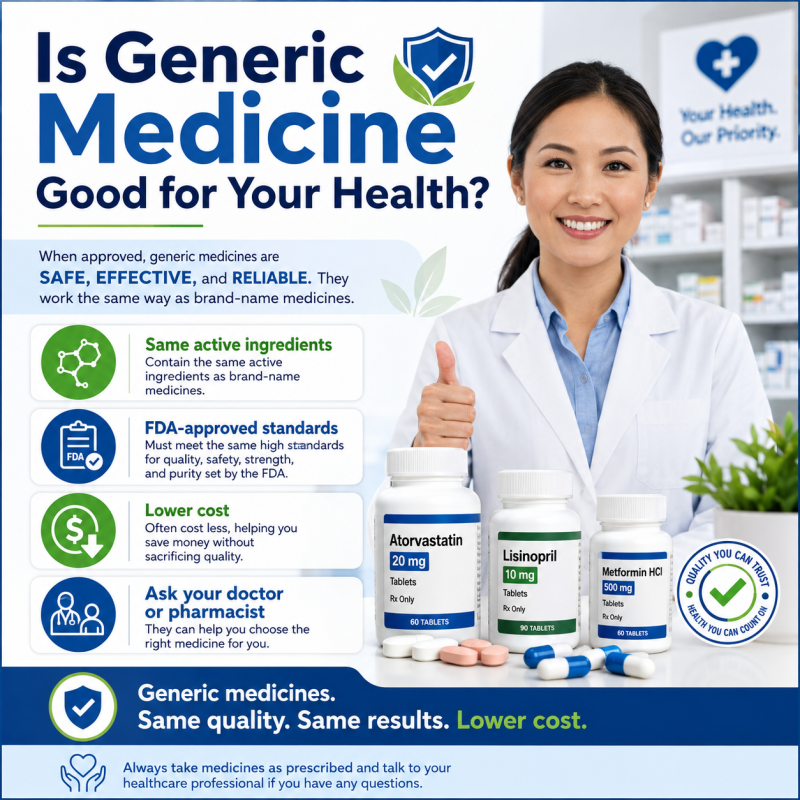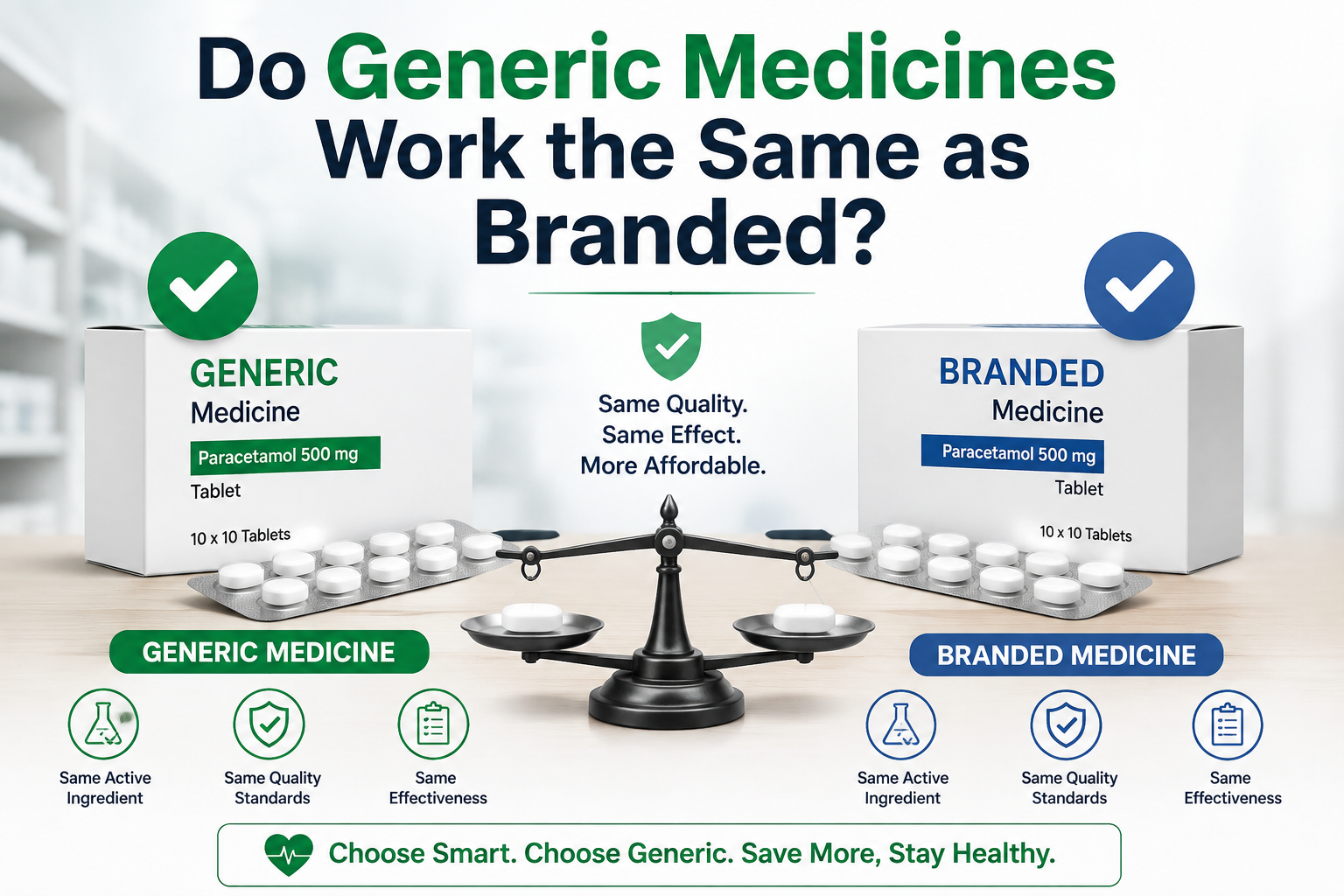
Yes — generic medicines work the same as branded medicines. They contain the identical active ingredient in the same strength and dosage form, and must demonstrate to India's drug regulator that they deliver that ingredient into your body at the same rate and in the same amount as the original. The doubt that many people feel is understandable — but it is not supported by the science or the regulatory evidence.
At our pharmacy counter in Moosapet, "will this generic actually work the same?" is a question we hear every single day. It deserves a complete, honest answer — not just reassurance. Here is the full explanation, with the reasoning behind it.
Why generic medicines are designed to work the same
A generic medicine is not a new drug — it is the same molecule as an existing approved medicine, manufactured after the original patent expires. Because the active ingredient is chemically identical, the mechanism of action inside your body is identical. Paracetamol 500 mg from any licensed manufacturer works through exactly the same pathway — it inhibits the same enzymes, produces the same fever reduction, the same pain relief.
The active ingredient does not change depending on who prints the label.
What is bioequivalence and why does it matter?
For many categories of medicine, proving the same active ingredient is not enough — the generic must also demonstrate bioequivalence to the original branded drug.
Bioequivalence means that the generic releases the same amount of active ingredient into the bloodstream, at the same rate, as the branded version. Regulators measure this using pharmacokinetic studies — participants take both versions and blood samples are analysed to compare how the drug is absorbed. If the two are statistically equivalent, the generic is approved. If they are not, it is rejected.
This is why bioequivalence is the cornerstone of generic medicine approval worldwide — including in India under the Central Drugs Standard Control Organisation (CDSCO). Same delivery into the body means same clinical effect.
What can differ — and why it usually does not matter
The inactive ingredients — binders, fillers, colourants, coatings — can differ between a branded and generic version. These excipients are what give a tablet its shape, colour, and texture. They affect appearance, not the active ingredient or its delivery.
For the vast majority of patients, these differences are completely irrelevant. In rare cases — usually involving specific allergies to a filler or coating — a patient may react differently to one formulation versus another. This is uncommon, and it is a reason to switch to a different generic manufacturer, not to avoid generics entirely.
Are generic medicines less effective than branded?
No — not when purchased from a licensed pharmacy. The belief that generics are "weaker" or "diluted" is one of the most persistent and most incorrect assumptions in everyday medicine. It likely comes from the significant price difference, which people understandably interpret as a quality signal. But the price difference reflects manufacturing cost — not the amount or quality of the active ingredient.
A branded medicine that costs ₹150 and a generic that costs ₹20 for the same salt and strength contain the same active ingredient. The price difference pays for the original company's research, marketing, and brand value — not for more medicine in the strip.
Do generic medicines have different side effects?
The side effects of a medicine come from its active ingredient — and since that ingredient is identical in branded and generic versions, the core side effect profile is the same. Occasionally, a patient may notice a difference in tolerability between two formulations of the same salt — this can relate to the inactive ingredients or the tablet coating. If this happens, switching to a different generic manufacturer often resolves it.
What you should never do is assume a generic is "not working" simply because it looks different, costs less, or comes in unfamiliar packaging. Appearance is not pharmacology.
The rare exception: narrow therapeutic index medicines
A small group of medicines — including certain thyroid medications (levothyroxine), anti-epileptics (phenytoin, valproate), and blood thinners (warfarin) — operate within a narrow therapeutic window. For these drugs, small differences in bioavailability can have clinical consequences. Switching between manufacturers — even between two generics — should only happen on your doctor's advice. Once switched, stay consistently with one manufacturer and monitor as advised.
This group represents a small fraction of total medicines prescribed. For everything else — pain relief, antibiotics, diabetes medication, blood pressure, cholesterol, vitamins, and most common conditions — a quality generic from a licensed pharmacy works the same as the branded version.
Quick reference: generic vs branded effectiveness
| Question | Answer |
|---|---|
| Same active ingredient? | Yes — identical by law |
| Same therapeutic effect? | Yes — bioequivalence required |
| Same side effects? | Yes — from the active ingredient |
| Same regulatory approval? | Yes — CDSCO approves both |
| Can appearance differ? | Yes — inactive ingredients vary |
| Any medicines where caution needed? | Yes — narrow therapeutic index drugs |
| Worth switching for most medicines? | Yes — same effect, lower cost |
How to switch to a generic confidently
Bring your current branded medicine or prescription to a registered pharmacist. Ask: "What is the generic equivalent for this salt and strength?" The pharmacist will match the active ingredient exactly — not just a similar-sounding name — and flag any medicines where your doctor's input is advisable before switching.
At Scanda Enterprises, our 2,200 sq ft pharmacy in Bhavani Nagar, Moosapet, a registered pharmacist is on duty 24 hours a day, 7 days a week. We stock generic equivalents for most common branded medicines and can show you both options with current prices on the spot. Walk in any time, or WhatsApp your prescription to 86880 60339 and we will confirm the generic match and price before you travel.
Customers who switch common chronic-condition medicines — diabetes, blood pressure, thyroid, cholesterol — to quality generics at our counter typically save 40–60% on their monthly medicine bill, with the same clinical outcome.
Frequently asked questions
Do generic medicines work the same as branded medicines?
Yes. They contain the identical active ingredient and must demonstrate bioequivalence — delivering the same amount of drug into the bloodstream at the same rate — before they are approved for sale in India by CDSCO.
Does generic medicine work the same in India?
Yes. Indian generic medicines are approved by CDSCO under the Drugs and Cosmetics Act, to the same standards as branded medicines. India is the world's largest supplier of generic medicines globally, including to the US and UK health systems.
Are generic medicines less effective than branded?
No — not when bought from a licensed pharmacy. The active ingredient is chemically identical. The price difference reflects manufacturing cost, not the amount or quality of medicine in the strip.
Can generic medicines have different side effects?
Core side effects come from the active ingredient, which is identical. Occasionally inactive ingredients differ and may affect tolerability — switching to another generic manufacturer usually resolves this.
Which medicines need extra care when switching to a generic?
Narrow therapeutic index medicines — certain thyroid, epilepsy, and blood-thinning drugs. Switch these only with your doctor's guidance, and stay consistent with one manufacturer once switched.
Where can I find quality generic medicines in Moosapet, Hyderabad?
Scanda Enterprises, 234/D, Bhavani Nagar, Moosapet, Hyderabad, Telangana 500018 — open 24 hours, 7 days a week. Call 86880 60339 or 080087 20077, or WhatsApp your prescription for pricing and availability.
This article is for general information and is not a substitute for medical advice. Always consult your doctor or a registered pharmacist before changing any medicine, particularly narrow therapeutic index drugs or medicines for chronic conditions.