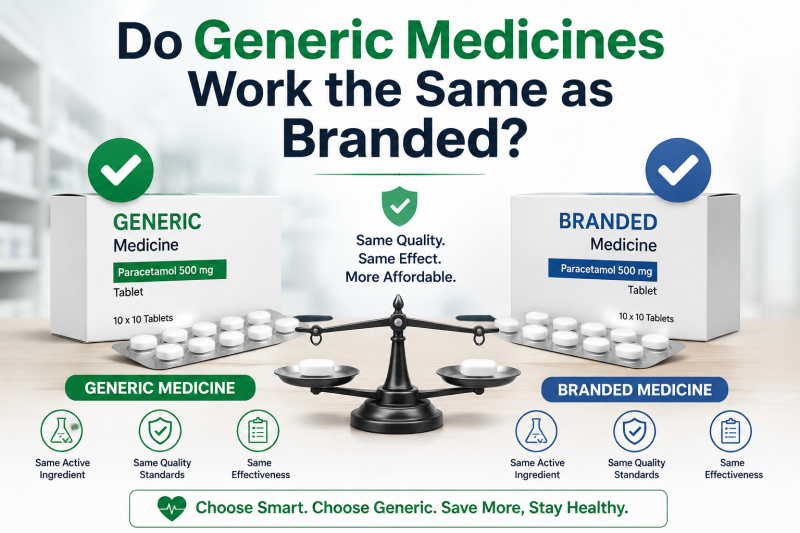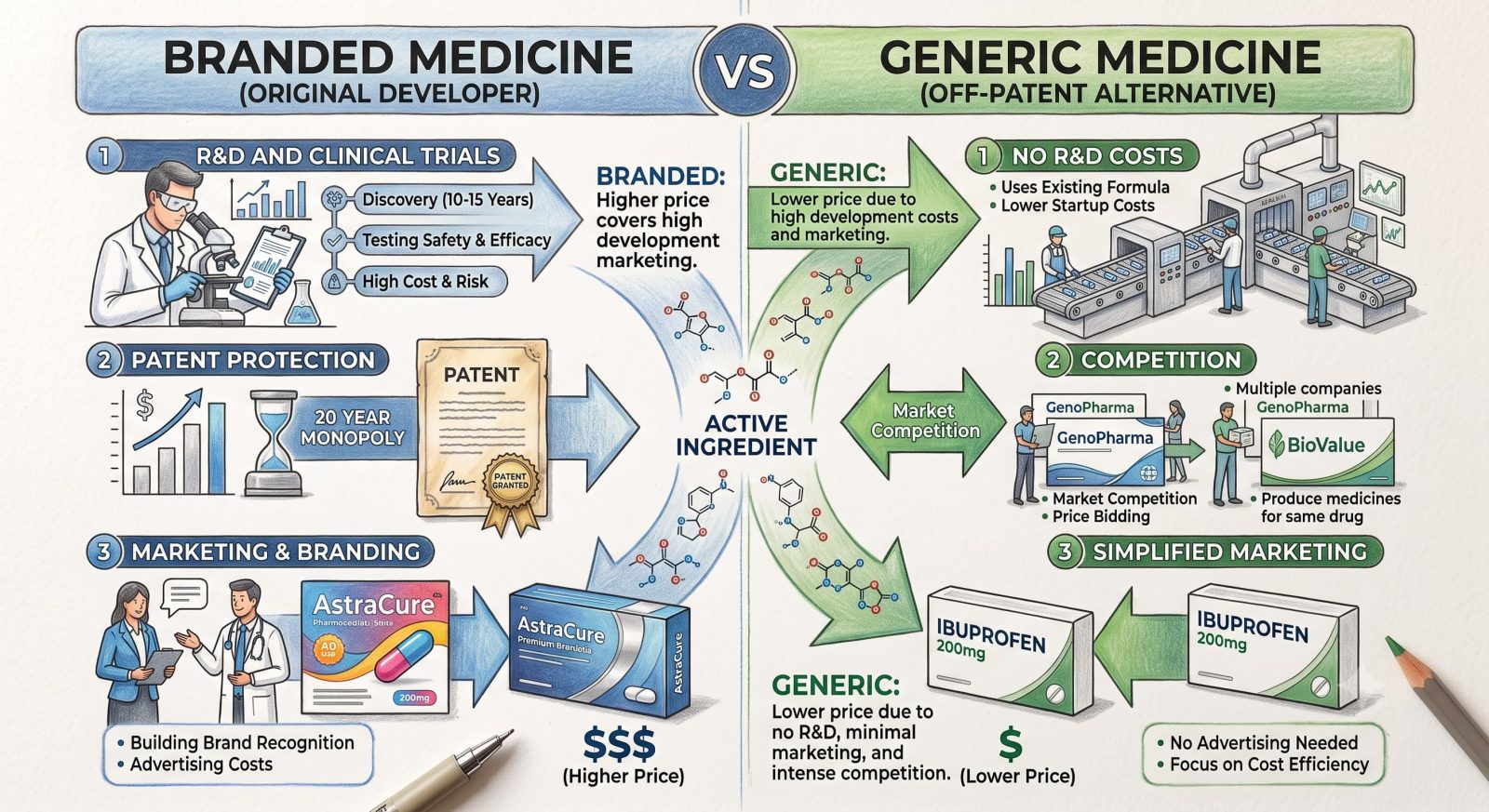
Generic medicines are cheaper than branded medicines because their makers don't pay for drug discovery, clinical trials, or marketing — they only pay to manufacture a formula that already exists. The active ingredient (the "salt"), dose, and effect are the same; what you're not paying for is the brand. In India, that difference is typically 50–90% off the branded price, which is why a ₹150 strip can have a ₹20 equivalent on the very same shelf.
At our pharmacy in Moosapet, "why is this one so cheap — is it weaker?" is the question we hear most at the counter. It's a fair question, and the answer changes how much your family spends on medicines every month. Here's the full explanation, in plain language.
First, what exactly is a generic medicine?
Every medicine has two names: the salt name (like paracetamol or atorvastatin) and the brand name a company sells it under. When a company invents a new drug, it gets a patent — usually 20 years — during which only that company can sell it. Once the patent expires, any licensed manufacturer can produce the same salt, in the same strength and form. That's a generic.
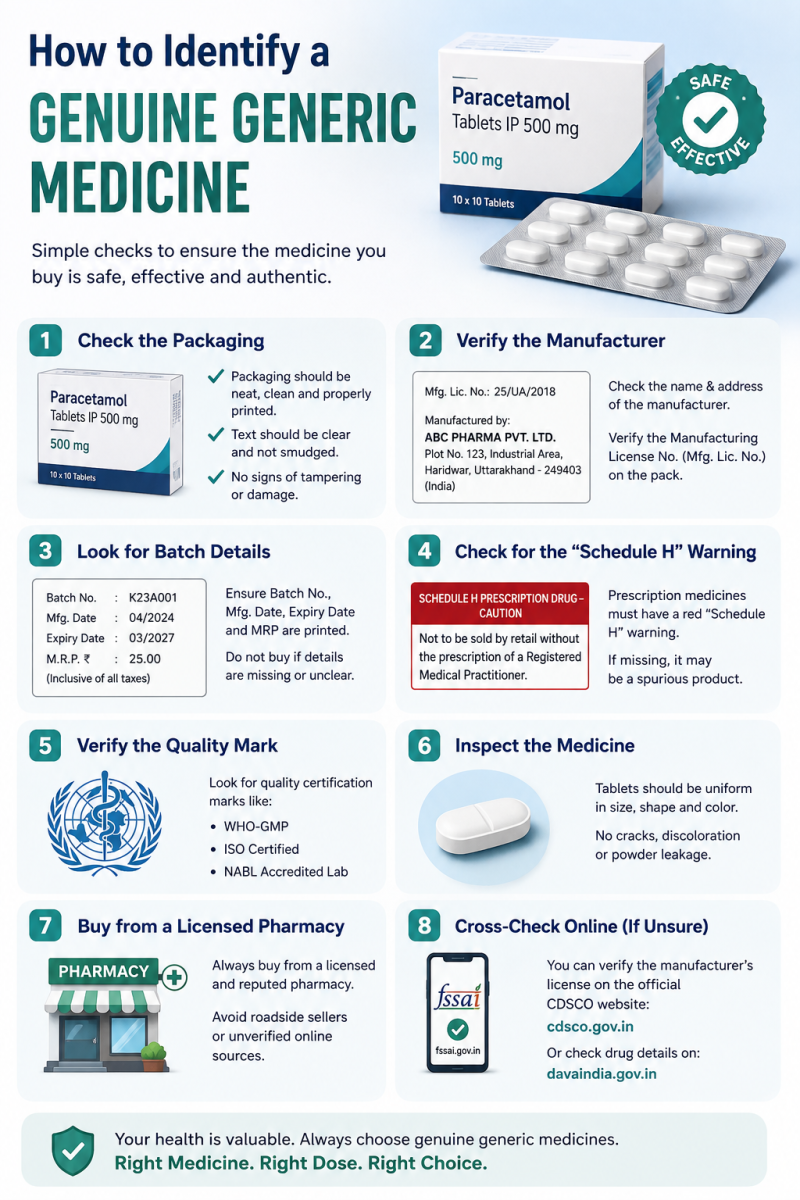
A generic is not an imitation or a "duplicate." It is the same active ingredient, approved by the same regulator (CDSCO in India), made in licensed facilities, and required to work the same way in your body.
The 5 real reasons generics cost less
1. No research and development costs to recover
Inventing a new drug costs the original company hundreds or thousands of crores across years of research and clinical trials — and most candidate drugs fail along the way. The branded price has to recover all of that. A generic manufacturer starts after the science is proven, so its price only needs to cover manufacturing, quality testing, and distribution.
2. Little to no marketing spend
A large share of a branded medicine's price funds promotion — medical representatives, doctor outreach, advertising, sponsorships. Generics are mostly bought on the pharmacist's recommendation or a doctor writing the salt name, so almost none of that cost exists.
3. Competition on the same salt
Once a patent expires, dozens of Indian manufacturers may produce the same salt. When twenty companies sell the same molecule, price becomes the main way to compete — and prices fall fast. India is the world's largest producer of generic medicines, so this competition is especially strong here.
4. Government price regulation and Jan Aushadhi
India's Drug Price Control Order (DPCO) caps prices on essential medicines, and the government's Jan Aushadhi programme sells quality-tested generics at prices that are typically 50–90% below branded equivalents. This sets a public benchmark that keeps the whole generic market honest.
5. No brand premium
Part of any branded price is simply the brand — the name you recognise from years of prescriptions. Trust is valuable, but it isn't pharmacology. The salt doesn't know what's printed on the strip.
Cheaper doesn't mean weaker: the same-salt rule
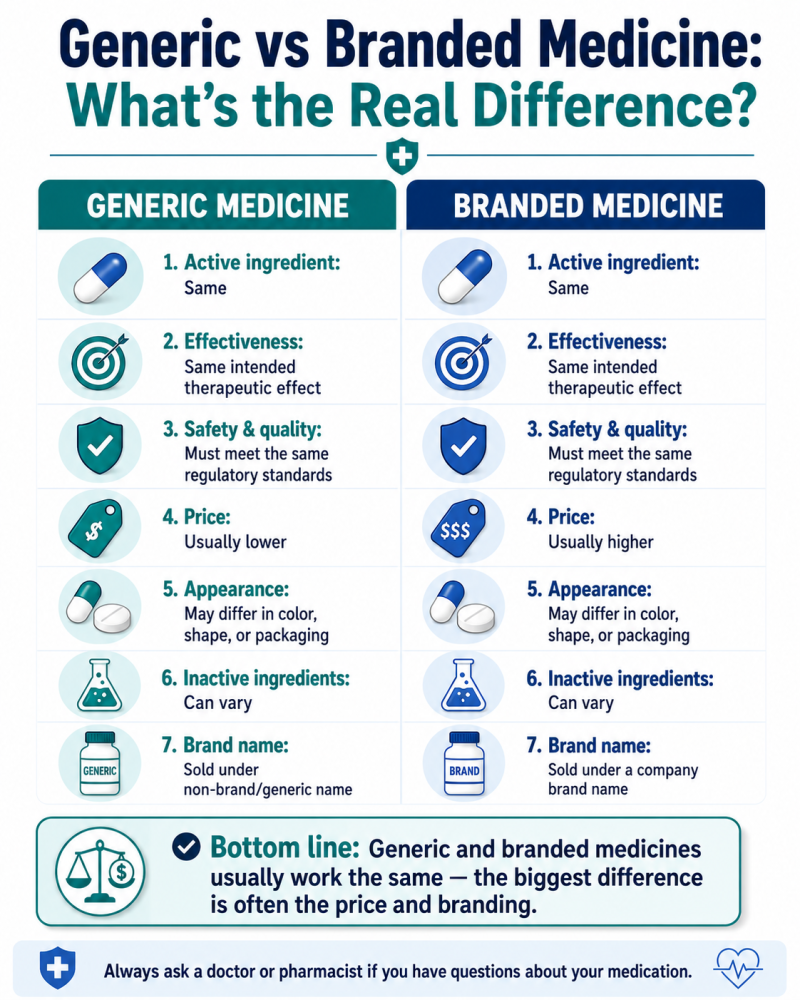
For a generic to be legally sold in India, it must contain the same active ingredient, in the same strength and dosage form, and meet the same pharmacopoeial quality standards as the original. For many products, manufacturers must also demonstrate bioequivalence — evidence that the medicine releases into your bloodstream the same way the branded version does.
What can differ is the inactive material: the binder, the coating, the colour, the shape of the tablet. These affect appearance, not treatment. If you've ever noticed your usual medicine looking different after a refill, this is usually why.
How much can you actually save? (real shelf examples)
Here are indicative comparisons from our own counter — the kind of gap we see every day. Exact prices vary by manufacturer and pack size:
| Medicine (salt) | Typical branded price | Typical generic price | Saving |
|---|---|---|---|
| Atorvastatin 10 mg × 10 tabs (cholesterol) | ₹XX | ₹XX | ~XX% |
| Metformin 500 mg × 10 tabs (diabetes) | ₹XX | ₹XX | ~XX% |
For a family managing diabetes, blood pressure, or thyroid conditions — where medicines are taken every single day for years — switching to generics routinely cuts the monthly medicine bill by a third or more.
Are there times you should NOT switch to a generic?
Yes, a few. For medicines with a narrow therapeutic index — where small differences in blood levels matter, such as certain thyroid, epilepsy, or blood-thinning medicines — switch only with your doctor's guidance, and then stay consistent with one manufacturer. And never change any prescription medicine on your own: the right step is to ask your doctor or pharmacist, "is there a generic equivalent I can safely take?"
How to switch safely: ask your pharmacist
Bring your prescription or your current strip to the counter and ask for the generic equivalent. A registered pharmacist will match the salt, strength, and form — not just a similar-sounding name — and tell you if your specific medicine is one of the few where switching needs a doctor's sign-off first.
At Scanda Enterprises in Moosapet, our pharmacy is supervised by a registered pharmacist round the clock, and we stock generic equivalents alongside branded medicines so you can compare prices on the spot — any hour, any day. You can also send your prescription on WhatsApp to 86880 60339 and we'll reply with both options and prices.
Frequently asked questions
Are generic medicines safe in India?
Yes. Generic medicines sold by licensed pharmacies are approved by India's drug regulator (CDSCO) and must meet the same quality standards as branded medicines — same salt, same strength, same effect.
Why do doctors sometimes prescribe branded medicines?
Habit, familiarity with a manufacturer, or specific clinical reasons. Since 2017, medical guidelines encourage doctors to prescribe by salt name where feasible — and you can always ask your doctor whether a generic is suitable for you.
Is Jan Aushadhi the same as generic medicine?
Jan Aushadhi is the government's own chain selling quality-tested generics at fixed low prices. All Jan Aushadhi medicines are generics, but generics are also available at regular pharmacies — including ours — often with a wider range of manufacturers and stock.
Where can I buy generic medicines in Moosapet, Hyderabad?
Scanda Enterprises, 234/D, Bhavani Nagar, Moosapet, Hyderabad 500018 — open 24 hours, 7 days a week. Call 86880 60339 or 080087 20077, or WhatsApp your prescription for home delivery.
This article is for general information and is not a substitute for medical advice. Always consult your doctor or a registered pharmacist before changing any medicine.